
How to Judge the True Quality of Mold Steel Based on Hardness, Toughness, and Wear Resistance
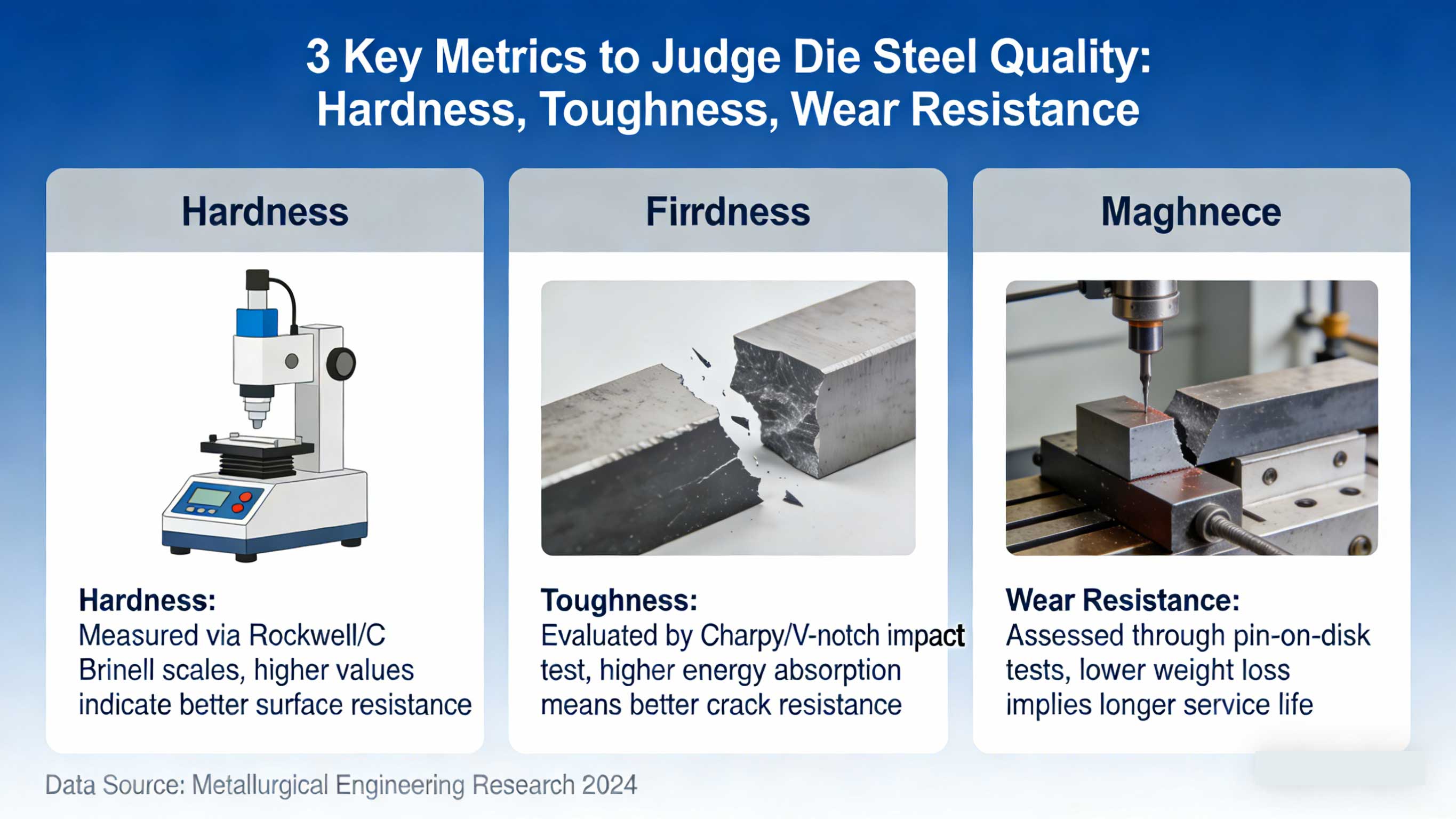
In the mold manufacturing industry,Many procurement professionals and mold makers tend to focus on only one parameter when reviewing material certificates: Hardness. The common belief is "the harder, the better." However, in real-world mold failure analysis, cracking due to insufficient toughness and cavity wear due to poor wear resistance are far more common than failures caused by inadequate hardness alone. Today, let's set aside the complex physical and chemical data sheets and explore how to assess the true performance of mold steel from three core dimensions: Hardness, Toughness, and Wear Resistance.
1. Hardness: Don't Just Look at the Initial Value, Look at Stability
Hardness is the first line of defense against deformation and compression. Using a Rockwell hardness tester (HRC) is standard practice, and that's fine. But the key to judging true quality lies in two factors:
Uniformity: High-quality mold steel exhibits a minimal hardness gradient from the surface to the core, with a dense and uniform structure. If only the surface is hard while the core remains soft, "orange peel" effects will quickly appear after polishing. If the hardness fluctuates across the block, "tool deflection" during machining will occur, making precision impossible.
Red Hardness: This is critical, especially for die-casting or hot work molds, where operating temperatures can soar above 600°C. Inferior steel will experience a sharp drop in hardness at these elevated temperatures, leading to early collapse, plastic deformation, or heat checking. True high-quality hot work steel (e.g., H13) must maintain sufficient hardness at high temperatures, exhibiting strong tempering resistance.
2. Toughness: Reject "Hard but Brittle," Pursue "Strength-Toughness Balance"
This is the most misunderstood parameter. Many pursue extreme hardness (e.g., above 60 HRC), only to find their chipping or cracking after just a few thousand cycles. This happens because hardness and toughness are often inversely related. Pursuing hardness at the expense of toughness is a recipe for disaster.
Judging true toughness involves looking at the impact energy (Joules). But more importantly, it requires examining the distribution of carbides. Under a metallographic microscope, if the carbides show severe banding or a network-like segregation, the steel is "outwardly strong but inwardly weak." It harbors significant internal stress and is highly prone to cracking during heat treatment. High-purity mold steel should have a uniform, fine-grained structure with finely dispersed carbides. This allows it to effectively absorb energy during impact without brittle fracture.
3. Wear Resistance: The Key Indicator of Mold Lifespan
Wear resistance directly determines how many production cycles a mold can consistently deliver. It is not simply a function of matrix hardness. It is determined by the combination of matrix hardness + the type, quantity, and morphology of carbides.
For example, high-chromium steel (like Cr12MoV) is rich in hard alloy carbides. These carbides act like a rigid skeleton within the matrix, resisting erosion from molten aluminum or abrasion from materials. If the steel's metallurgical quality is poor, resulting in coarse or segregated carbide particles, they won't effectively resist wear. Instead, they become initiation sites for cracks, leading to micro-spalling and premature failure. True wear resistance comes from a high-hardness matrix uniformly reinforced with fine, hard alloy carbide particles.
Conclusion: Choose the Right Steel, Build a Better Mold
Judging the true quality of mold steel requires looking beyond the pretty data sheet and understanding its internal micro structure.
Hardness is the foundation, ensuring the mold resists deformation.
Toughness is the safeguard, ensuring the mold resists cracking and fracture.
Wear resistance is the result, ensuring long life and stable production.
The next time you select mold steel, ask your supplier: "What is the impact toughness value? What about the isotropy? What is the carbide level?" When you start paying attention to these deeper indicators, you'll be one step closer to the goal of "zero mold failure."
Have you encountered any mold failure cases caused by deceptive steel quality in your work? Feel free to share and discuss in the comments.
Die Steels Cr12MoV, D2 and SKD11: Commonalities, Core Differences and Selection Guide for Replacement
UTSTEEL TTP20
Related Article

