
NAK80, S136 and P20 are all widely used as plastic mold steels.What are the key differences between them?
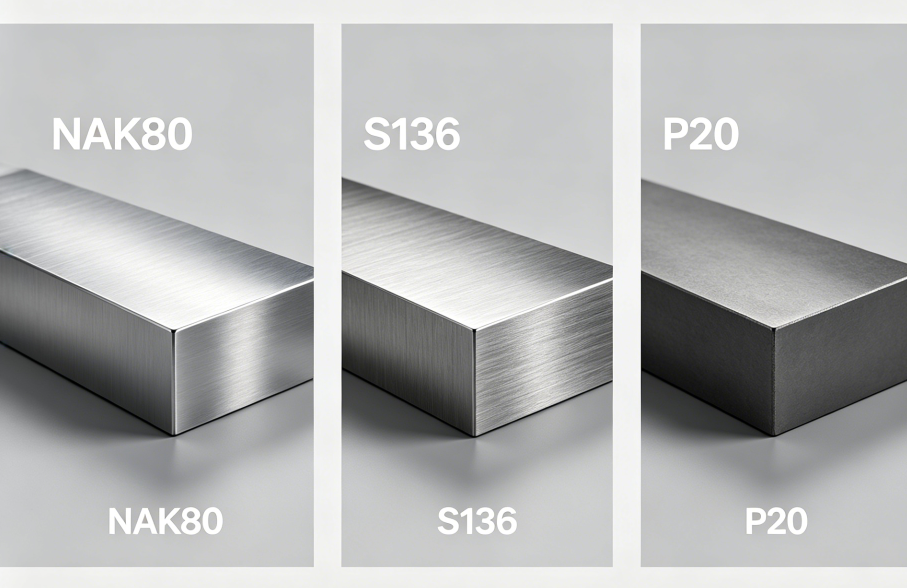
NAK80, S136 and P20 are all widely used as plastic mold steels.What are the key differences between them?As a professional steel manufacturer, we summarize their core properties and application scenarios for your quick reference.
Below is the refined analysis of NAK80, S136 and P20. 🛠️
✨ NAK80: Precision Mirror Mold Steel
Ni-Al-Cu pre-hardened precipitation hardening steel (37~43 HRC), directly machinable without heat treatment.
- Mirror Polishing: Vacuum-melted, Ra ≤ 0.05 μm, no defects.
- Machinability: Cutting resistance 20% lower than S136, easy to polish after EDM.
- Stability: Deformation rate < 0.05%; Wear/corrosion resistance for ABS + flame-retardant plastics.
Applications: Transparent products, optical components, high-end cosmetic/medical molds.
🔍 S136 vs P20: Core Differences
1. Material & Corrosion
- S136: 4Cr13 (Cr~13.6%), excellent corrosion resistance.
- P20: 3Cr2Mo, weak corrosion resistance.
2. Hardness & Wear
- S136: 48~52 HRC, wear-resistant (extendable by coating).
- P20: 28~34 HRC, for general non-high-wear scenarios.
3. Polishing & Machining
- S136: Ra ≤ 0.015 μm, complex heat treatment.
- P20: Up to #6000 mesh, direct machining, cost-effective.
4. Application & Cost
- S136: High cost, for corrosive/medical/food-grade products.
- P20: Low cost, for household appliances/automotive interior.
📌 Selection Guide
- NAK80: High-precision mirror molds; S136: Corrosive conditions; P20: Cost-sensitive projects.
We provide high-quality NAK80/S136/P20 with stable performance. Welcome to comment for customized needs! 💬
Below is the refined analysis of NAK80, S136 and P20. 🛠️
✨ NAK80: Precision Mirror Mold Steel
Ni-Al-Cu pre-hardened precipitation hardening steel (37~43 HRC), directly machinable without heat treatment.
- Mirror Polishing: Vacuum-melted, Ra ≤ 0.05 μm, no defects.
- Machinability: Cutting resistance 20% lower than S136, easy to polish after EDM.
- Stability: Deformation rate < 0.05%; Wear/corrosion resistance for ABS + flame-retardant plastics.
Applications: Transparent products, optical components, high-end cosmetic/medical molds.
🔍 S136 vs P20: Core Differences
1. Material & Corrosion
- S136: 4Cr13 (Cr~13.6%), excellent corrosion resistance.
- P20: 3Cr2Mo, weak corrosion resistance.
2. Hardness & Wear
- S136: 48~52 HRC, wear-resistant (extendable by coating).
- P20: 28~34 HRC, for general non-high-wear scenarios.
3. Polishing & Machining
- S136: Ra ≤ 0.015 μm, complex heat treatment.
- P20: Up to #6000 mesh, direct machining, cost-effective.
4. Application & Cost
- S136: High cost, for corrosive/medical/food-grade products.
- P20: Low cost, for household appliances/automotive interior.
📌 Selection Guide
- NAK80: High-precision mirror molds; S136: Corrosive conditions; P20: Cost-sensitive projects.
We provide high-quality NAK80/S136/P20 with stable performance. Welcome to comment for customized needs! 💬